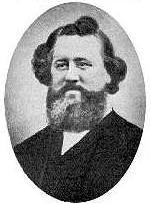
John Moburn Kay
BORN: 6 Oct 1817 BURY, LNCSH, Engl to William and Elizabeth Moburn Kay
MARRIED: 19 June 1851 Salt Lake City, Salt Lake, Utah to Ellen Marie Partington (Richards)
Died: 27 Sep 1864 Nr Little Larami, , WY

History - John Moburn Kay, an Elder of the Church who died while returning from a foreign mission. His father, James Kay, was a foundry man, and the boy himself, at the early age of six years, entered his uncle's iron and brass foundry in Bury, mastering the trade and getting journeyman's wages at seventeen.
His musical ability was manifest at an early day, both vocally and instrumentally. He had a fine, healthy physique, and was so agile in jumping and in other manly sports that he was called the "India rubber man." The only schooling he received was in Sunday school. His jovial nature and keen sense of humor, frequently displayed in harmless, practical jokes, made him one of the most entertaining of men. His spirit was chivalrous and he would always defend the oppressed.
It was partly due to his disposition that he became a Latter-day Saint. One of his fellow employees (Samuel Croyer) at St. Helens, to which town he had removed to work in a foundry, was a member of the "Mormon" church, and being a small, timid man, he was ridiculed by his shopmates, who went so far as to offer him violence. Without knowing anything about his religion, John Kay defended him and thrashed his leading assailant. Curiosity then led him to inquire into the little man's faith. The result was his conversion and baptism in the fall of 1841.
He was immediately ordained an Elder, and for some time labored in the ministry, but in September, 1842, he sailed for America, reaching Nauvoo, Ill., in the ensuing spring (1843). There he became a major in the famous Nauvoo Legion; also a member of the Nauvoo brass band and the police force. Owing to his musical talent and his genial social qualities, he was often invited by the Prophet Joseph Smith to assist in the entertainment of visitors.
In the exodus from Illinois, he was with President Young's company, which he and others helped 'to sustain by going into Missouri and giving concerts, from the proceeds of which supplies for the destitute people and hungry animals were obtained. He afterwards joined Bishop Miller's company and spent the winter of 1846-47 among the Ponca Indians. On the way back to Winter Quarters he came near starving, and the cold was so intense that his feet were badly frozen. He and another messenger had been sent after provisions for the hungry people at Ponca. John Kay crossed the plains with his own teams, but traveled in the company led by President Young in the emigration of 1848, arriving in Salt Lake Valley on the 20th of September, 1848.
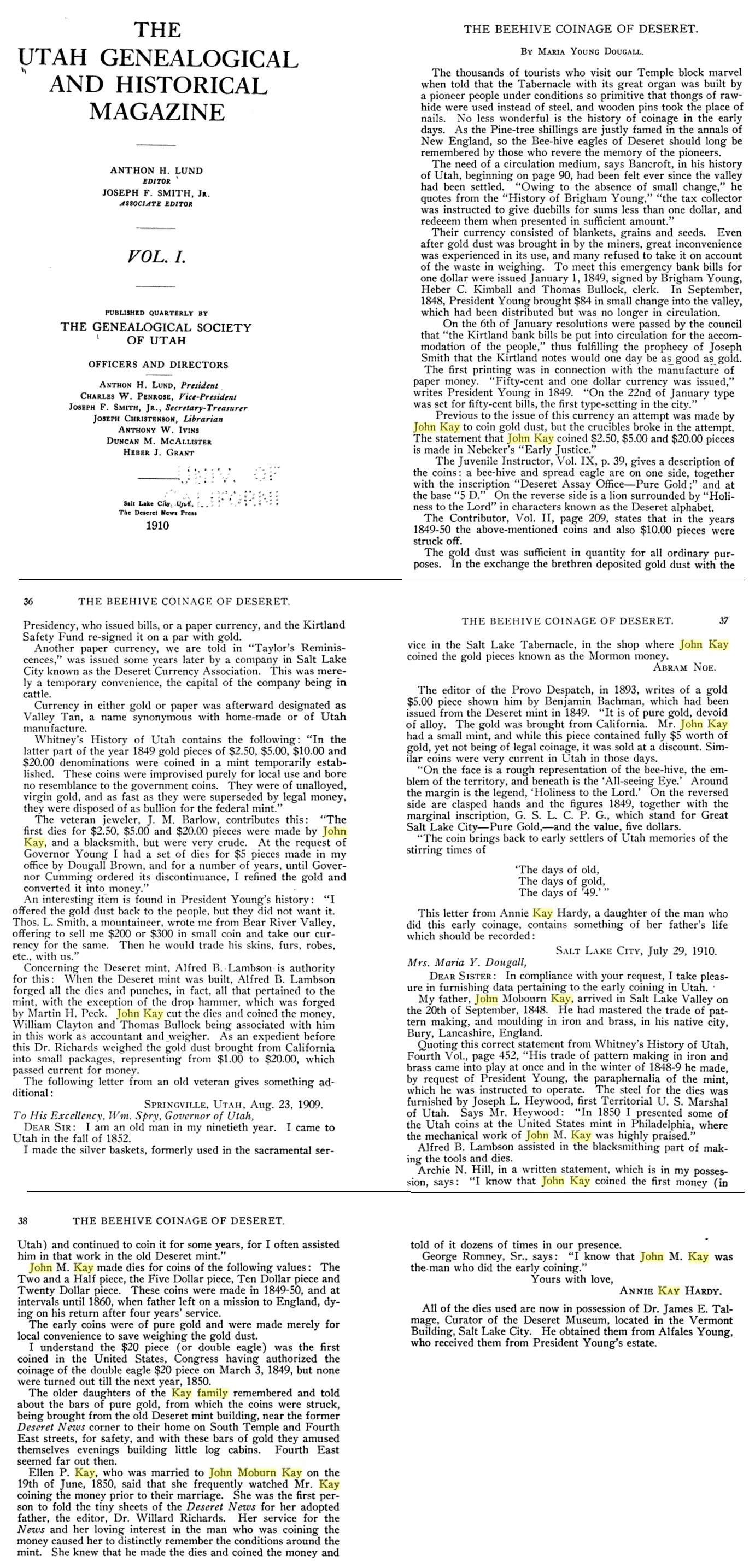
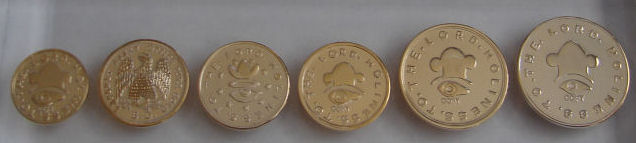
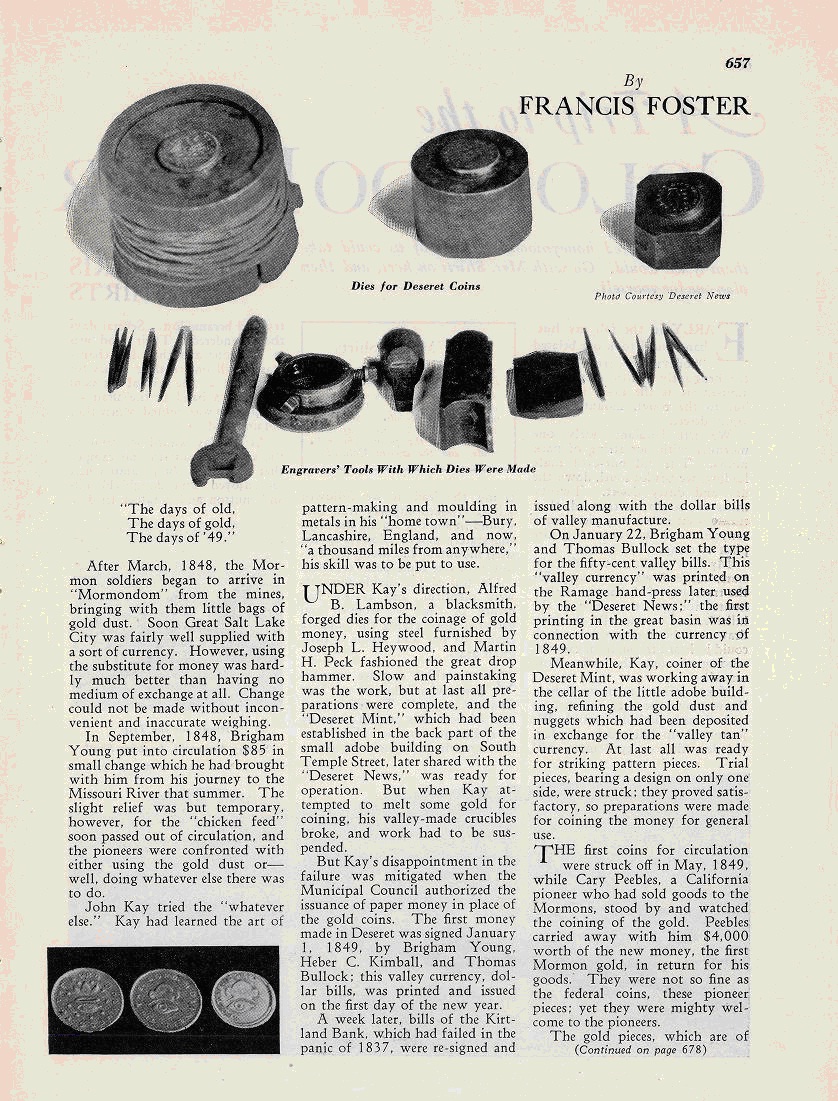
He settled permanently on the corner of South Temple and Fourth East Streets, where a portion of his family still resides. His trade of moulding and pattern-making in iron and brass came at once into play, and in the winter of 1848-1849 he made, by request of President Young, the paraphernalia of the mint, which he was instructed to operate. The steel for the dies was furnished by Joseph L. Heywood, and Bro. Kay was assisted in the blacksmithing work by Alfred Lambson. Says Mr. Heywood, who was Utah's first United States marshal: "In 1850 I presented some of the Utah coins at the United States Mint in Philadelphia, where the mechanical work of John M. Kay was highly praised." Bro. Kay is said to have made the first brass casting in Utah, also the first iron casting, assisted by Phillip Margetts and another worker.
He rendered service in the early Indian wars, sometimes acting as surgeon, for he had studied surgery and dentistry, which he practiced during the remainder of his life. In 1855-1858 he was absent upon a mission to Europe, from which he returned in company with Orson Pratt and other Elders by way of the Isthmus of Panama and the State of California, arriving in Salt Lake City in January, 1858.
He saw service in Echo Canyon, as one of Governor Cumming's escort to Salt Lake City, appointed specially to entertain his Excellency; and was on guard in the city when Johnston's army passed through. In the fall of 1860 he went upon another mission to Europe, where he labored as before in his native land, though on the former occasion he had traveled some on the continent. This last mission extended through four years.
Honorably released, he set out to return to Utah, but did not reach home alive. It was at the head of a company of emigrating saints that he sailed from London June 3, 1864, on the ship "Hudson." After reaching New York July 19th, his labors were very arduous. He was a large man, weighing about two hundred and fifty pounds, and the weather was extremely warm. The Civil War was closing, and some of the troops encountered by the emigrants on the way to the outfitting camps at Wyoming, Neb., manifested much bitterness towards them. At one point they drove them through a river, with the rain descending in torrents, which exposure caused much sickness and some deaths in the company. Expostulating with the soldiers on their conduct, Elder Kay said: "If you have no respect for the living, will you not look with mercy on the sick and dying, and consider the sacred dead?" In reply one of the soldiers said, "If you say another word, I will rip you up, if you were Jesus Christ himself."
After reaching the point where he was relieved of his command by the arrival of the Church teams from Salt Lake Valley, the devoted Elder fell sick—some sqid with mountain fever. He traveled on with the rest, however, and seemed to improve up to the evening before his death, when he stood in his tent door and sang, as he had often sung, to cheer the hearts of his fellow pilgrims to Zion.
He died suddenly and apparently without pain, at 2 o'clock in the morning of Sept. 27, 1864, at a point seven miles west of Little Laramie, in what was then the Territory of Colorado. They buried him at the foot of the Black Hills, taking a board from each wagon until sufficient lumber was procured to make a coffin in which to enclose his remains. His death caused profound sorrow in Utah and England, and wherever he was known.
John M. Kay was not only a man of gifts, he was also a man of integrity. A fitting epitaph to his noble life is found in his own words, uttered to a friend on leaving England. "With all my faults, I never saw a moment since I knew the truth that I did not love it, and was not willing to place my body in the gap to save my brethren from danger."
By vocation a foundryman and by nature a musician of marked ability, John M. Kay was one of the picturesque figures of early times in Salt Lake City. He was a born master of song, the possessor of a melodious and stentorinn voice, and his soul-stirring vocalism in the sacred songs of Zion not only charmed the fireside circle and larger social gatherings, but gladdened the hearts of thousands of homeless pilgrims, plodding their way over barren plains and bleak mountains to the haven of their hopes in the West. As a singer and an actor he appeared frequently upon the stage of the Social Hall and was known as a comedian of rare merit.
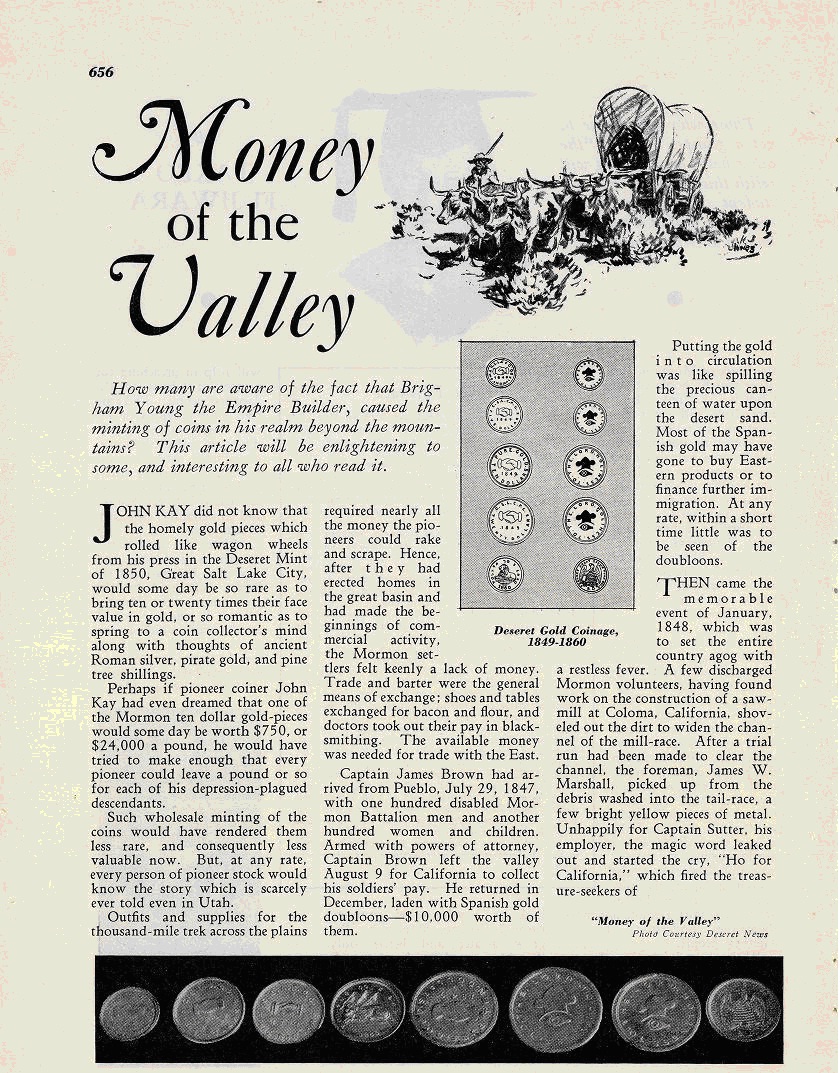
Scarcely second to his musical and dramatic gifts was his skill as a mechanic, a worker in metals. He made the dies and the tools with which the dies were made for the mint which coined in 1849 out of California gold dust, the first gold coins used in the intermountain region.
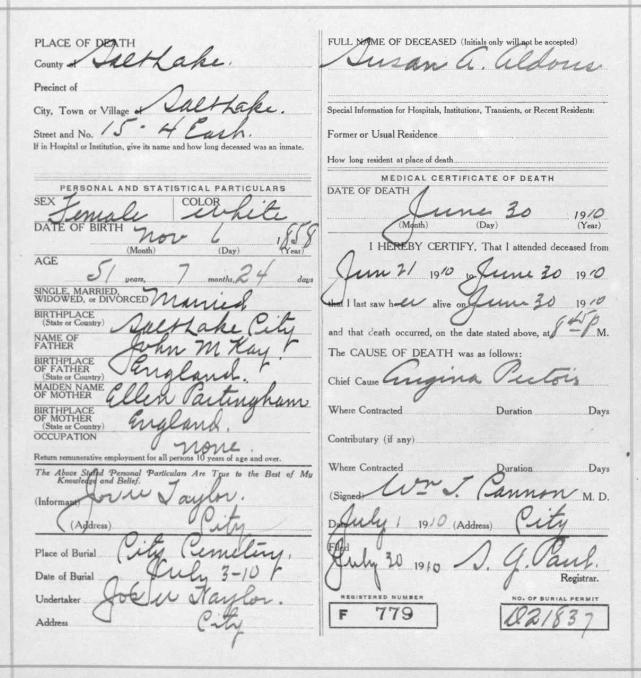
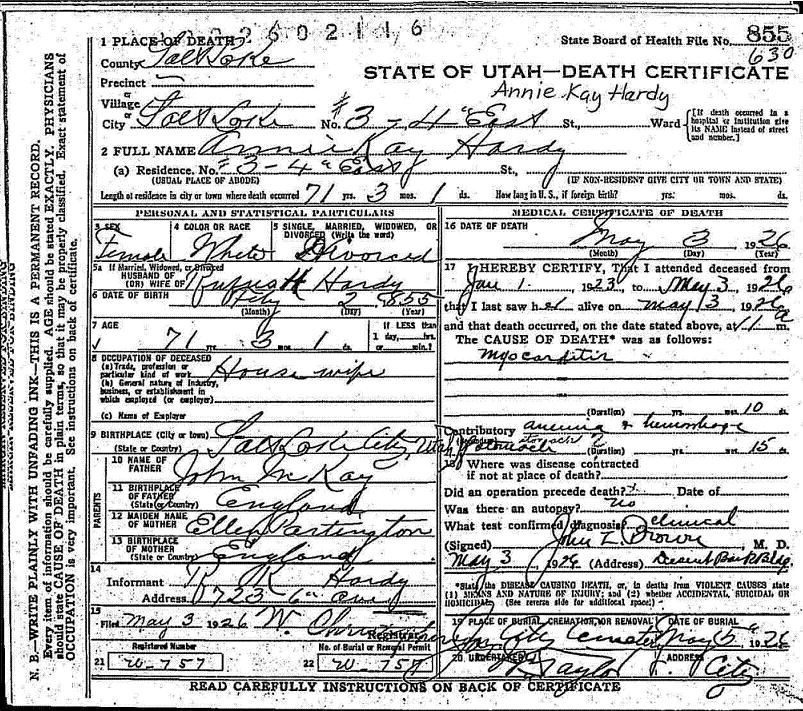
When only nineteen years of age, Bro. Kay married Ellen Cockroft, an English girl, who bore him six children, namely, Sarah (who married Leo Hawkins), Elizabeth (who married William H. Shearman), Mariah (who died on the plains in 1848), Ellen (who married Dr. J. K. Robinson), and two boys who died in infancy. While in Nauvoo, Illinois, he married Susan Miller as a plural wife, but had no children by her, and after his arrival in the Valley he married Ellen Partington, who bore him four children, namely, James Willard, who died seventeen years of age as a result of an accident, Annie (who married Rufus H. Hardy), Susan Amelia (who married Heber Brewer Aldous), and Leo (who died in infancy). Bro. Kay also married Martha Royal, who died soon after her marriage and left no children.
Notwithstanding the strenuous efforts which have been made, by his family, the exact location of the grave of Bro. Kay is still unknown.
Mormon Pioneer Overland Travel, 1847–1868
Source of Trail Excerpt:
Symons, Charles William, [Autobiography], in Juvenile Instructor, Sept. 1931, 519.
Read Trail Excerpt:
After inspection by Custom officials we were directed to railroad cars to convey us to the Frontiers. It was no small job to locate a company with freight, but finally two sections were formed and we were on our way. Travel on cars was not very commodious and not very clean. It was also slow for bridges and railroad tracks were torn out by Confederate armies, and freight had to be carried across rivers and creeks where train crews awaited to convey us to our destination. At Saint Joe we were placed on a Missouri River boat which carried us to Wyoming, Nebraska, and outfitting point for the journey cross the plains. For two weeks we lived in a little brush shelter awaiting preparations for the journey over the plains, loading of wagons, with freight of 900 people being tedious and slow. It required 120 wagons with from two to four yoke of cattle. Finally one train of 60 wagons and oxen was in shape and Captain Hyde placed in charge. On account of Indian depredations they halted and waited for the next train to overtake them so that they would be stronger in case of attack from Indians.
"I was engaged to drive one of the teams to Salt Lake, the agreement being my fare and board as well as that of my mother for my services. This was new work for me as I had never seen any oxen yoked before, but by watching old teamsters it soon became easy. Experience taught me that kindness to oxen availed much for the cattle came to know my voice. While many accidents occurred, I had no trouble from the Missouri River to Salt Lake, Mother rode in the front of the company and I with the rear guard, so she had a fire started an hour before I came into camp at night and something hot ready for a meal. One night coming in I found no fire nor supper and found mother very ill. She said, 'I am afraid I shall not live to get to Zion.' I answered, 'Yes, mother, you will live to get to Zion and will live for 20 years among the Saints,' which promise was fulfilled.
"John [Moburn] Kay, president of the company on the ship 'Hudson' died on the plains and we made a rough box and dug a hole for burial. Other deaths also occurred and I assisted in their burial.
"We arrived at the 8th Ward Square where the City and County building now stands, on November 2, 1864 in Captain Warren S. [Stone] Snow's wagon train. It was a cold reception for we had no relatives or friends to greet us.
OBITUARY.
Died on the 26th of September, 1864, of apoplexy, and a point seven miles this side of Little Laramie, Colorado Territory, on his return from a mission to England, John Moburn Kay, aged 46 years, 11 months and 20 days.
Elder John M. Kay was born on the 6th of October, 1817, in the town of Bury, Lancashire, England. He entered the Church of Jesus Christ of Latter-day Saints, in the fall of the year 1841, being baptized at St. Helens, Lancashire, by Elder John Nightingale, and was ordained an elder immediately afterwards, by Elder John Allen. His first acquaintance with the Latter-day Saints and the principles of the gospel was made under circumstances which exhibited his disposition to resist oppression and defend the weak—a disposition which he possessed through life. One of his fellow-workmen—a small timid man—had joined the Church and been ordained an elder, and occasionally preached the gospel. His shopmates ridiculed him, and even went so far as to attempt violence upon him. Without knowing anything about his religion, but seeing that he was being imposed upon, Br. Kay defended him, and thrashed his leading assailant. He than felt sufficient curiosity to inquire of the man whom he had befriended about his belief, and after investigation, became satisfied of its truth, and obeyed it. After his baptism and ordination, though he labored at his business, he traveled and preached with considerable success in the neighboring villages and towns. But the spirit of gathering had seized him at his baptism, and he spared no efforts to obtain the necessary means to emigrate to Zion. He sailed from England in September, 1842, and reached Nauvoo early in the spring of 1843. In February, 1846, the first camp moved across the Mississippi river on its journey westward; he was one of that camp. He spent the next winter with Bishop Miller's company, north-west of Winter Quarters among the Panceah [Ponca] Indians. In the fall of 1848 he reached Great Salt Lake Valley. He was appointed on a mission to England in the spring of 1855, where he remained—with the exception of a few weeks spent in visiting the branches of the Church on the Continent—until the contractor's war with Utah under the Buchanan administration broke out, when in company with Elders Orson Pratt and Ezra T. Benson, and several other elders, he sailed for New York, and from thence by the isthmus of Panama to San Francisco, California. He came from there by the Southern Route, and arrived in this city in January, 1858. Appointed on another mission to England in the fall of 1860, he started—though suffering severely from an attack of inflammatory rheumatism, as he was also at the time he started on his first mission—and labored faithfully and uprightly, and to the satisfaction of his brethren, for three years and a half in that country. On leaving England to return home, he was appointed to preside over the company of Saints which sailed from London on the Ship, Hudson. After reaching New York, and between there and Wyoming, his labors were very arduous; his ambition prompted him to make exertions which were scarcely suitable in hot weather for a fleshy a man as he was—his weight being usually about 250 lbs. He was taken sick after reaching Wyoming and continued so for some distance on the plains. For some days before his death, however, his health apparently improved, and he was able to move about with considerable ease, and even did so the day and evening before he died. His death was very sudden, and doubtless without pain. One hour before he expired, he conversed with his wife, and dropped off to sleep again. He gave a great start which woke his wife, and all was over.
Br. Kay's integrity is exemplified by a remark which he made to the writer before leaving England. Said he, "with all my faults, I never saw a moment, since I knew the truth, that I did not love it and was not willing to place my body in the gap to save my brethren from danger." This was his character. In times of difficulty and danger, he could safely be relied on, and he was always on hand for service. His influences with the Saints among whom he labored was always of an excellent character, he was wise in counsel and took a fatherly interest in their welfare. His death will be regretted by them wherever he was known. But though to his family and friends his death is a loss which they feel severely, it is not so to himself. He has passed away at the close of a mission, faithfully performed, and we can reflect with pleasure on his memory and labors, knowing that "they, which be of the faith are blessed with faithful Abraham."—[G. Q. C.
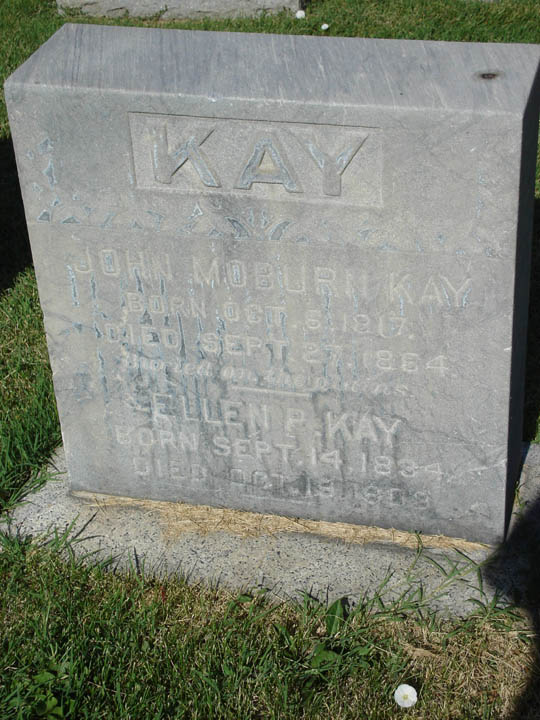
CHILDREN
Susan Amelia (Millie) Kay (1858-1910)
Annie Kay
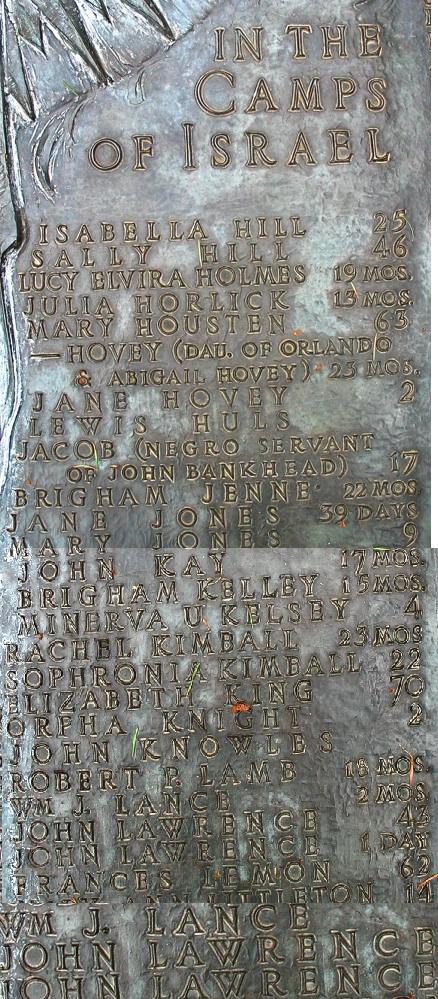
John Kay (inafant son of Ellen Cockcroft - 1814-1890)
Return to top
HOME